Energy Policy TRACKER · Monthly intelligence
Understand the policy shaping Japan’s energy market.
Monthly intelligence on Japan’s energy policy, electricity-market rules and government council discussions. Energy Policy TRACKER helps your team understand what changed, what remains under discussion and which developments deserve closer business review.
What is Energy Policy TRACKER?
A subscription information service that turns Japanese energy and electricity policy material into a regular briefing for business teams.
Experienced analysts monitor energy and environmental councils convened by bodies including the Ministry of Economy, Trade and Industry (METI) and the Ministry of the Environment (MOE), then compile monthly reports. The service helps readers follow important discussions across committees without reading every document from the beginning.
For international companies entering or expanding in Japan, this provides a practical starting point for policy awareness, internal discussion and more focused questions to local specialists. It complements Enegaeru’s energy simulation and data services.
Service roles: TRACKER is operated by Energy and System Planning Co., Ltd. Kokusai Kogyo introduces the service as a sales partner. Confirm the contracting entity, licensed users, current package and delivery language in your quotation.
Visual explainer
Connect policy status to the action your team should take.
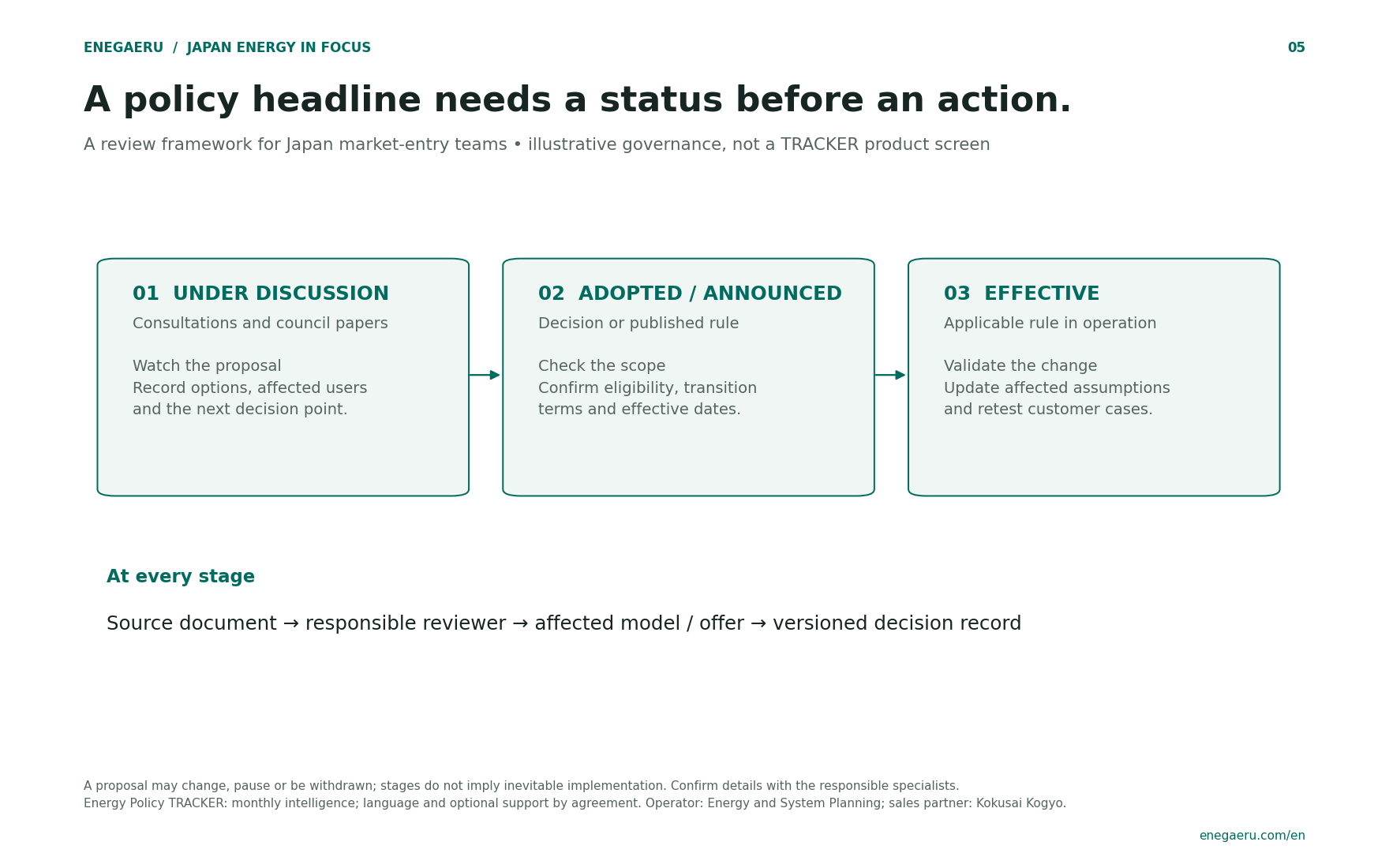
Read the diagram, assumptions and sources
- Under discussion: record the source, options, affected users and next decision point.
- Adopted or announced: confirm the actual decision, scope, eligibility, transitional provisions and effective dates.
- Effective: validate the applicable rule, update affected assumptions and retest the relevant customer cases.
At every stage, retain the source, responsible reviewer and decision record. Proposals can be changed, paused or withdrawn; the arrows do not imply inevitable implementation.
This is an editorial governance framework, not a product screenshot or a claim that TRACKER performs automated model updates. Energy Policy TRACKER is a route to monthly intelligence. Energy and System Planning operates the service; Kokusai Kogyo is a sales partner. Report language and optional support are agreed separately.
Who uses it—and what gets easier?
Country leaders & strategy teams
Build a recurring Japan-policy review into your business planning. Identify developments that could affect a launch, partnership, investment thesis or budget before assigning a deeper investigation.
Electricity retailers & energy providers
Follow policy discussions relevant to tariffs, procurement and market operations. Give product, commercial and regulatory teams a common starting point for review.
Solar, storage & PPA businesses
Identify discussions that may change project assumptions or market opportunities. Prioritize the questions to examine for generation, battery storage and renewable electricity supply.
Manufacturers & mobility businesses
Discuss the monitoring scope relevant to solar equipment, batteries, BEVs, V2H or charging. Translate policy awareness into questions for product planning and local partners.
Corporate energy buyers & finance teams
Bring policy developments into procurement and investment conversations. Separate a potential future change from a rule that can already be used in a project assessment.
Analysts & business-development teams
Reduce fragmented reading across sources and committees. Prepare better-informed internal briefings and customer discussions, with follow-up research focused on the issues that matter.
The monthly report: a regular view of the policy landscape.
The published service description identifies monthly reports that summarize council activity, highlight important discussions and explain relevant policy topics. Use the monthly review to understand the broader direction, then investigate the material most relevant to your business.
| Reader’s question | How to use the monthly report |
|---|---|
| What happened this month? | Review the council activity and key topics summarized for the reporting period. |
| What is worth reading closely? | Identify the important discussions and the underlying material your team needs to examine. |
| What could change for our business? | Use the policy topics to frame questions about products, procurement, project economics or partnerships. |
| What is still uncertain? | Check the source and policy stage before treating a discussion point as a confirmed operating assumption. |
| Who should act next? | Route selected topics to the responsible commercial, technical, regulatory or finance colleagues. |
The right-hand column describes practical ways to use the service, not a promise that every report contains bespoke analysis for your company. Confirm current report contents and request an available sample before subscribing.
A service that extends beyond the monthly report.
| Component | Published service description | Confirm for your subscription |
|---|---|---|
| Monthly policy report | Summaries of council meetings and explanations of important policy topics. | Reporting period, delivery schedule, current sample, format and language. |
| Council and meeting calendar | A calendar of relevant councils and study groups, described in the brochure as part of the portal. | Current portal access, calendar coverage and update arrangements. |
| Selected news summaries | Selected industry news with summaries and commentary. The brochure describes morning distribution. | Current frequency, distribution method and topics included. |
| Optional follow-up discussion | The brochure describes a monthly follow-up meeting for interested companies, including discussion of selected themes. | Availability, participants, meeting language, agenda and additional fees. |
| Individual analysis and reports | The brochure introduces reports that organize public information on selected industry topics. | Available titles, commissioned work, delivery timing and separate pricing. |
These components are described in the published service materials. The available package and options are confirmed when ordering. The linked brochure includes historical examples and a February 2021 version label; it is not a current price list or a guarantee of unchanged specifications.
Define the policy questions around your Japan business.
Start with the decision you need to make. The examples below help define a monitoring brief; they are not a fixed list of topics included in every subscription.
| Business area | Examples to discuss when defining scope | Decision the information can inform |
|---|---|---|
| Solar PV & renewable generation | Renewable-energy support frameworks, FIT/FIP discussions and grid-related policy. | Which assumptions should the project-development team investigate or test? |
| Battery storage & flexibility | Storage-related policy, market participation and flexibility discussions. | Which proposed revenue or operating assumptions need specialist validation? |
| Electricity retail & procurement | Electricity-market design, retail policy and tariff-related discussions. | What should product and procurement teams examine before revising an offer? |
| On-site & off-site PPAs | Policy developments relevant to renewable procurement and supply structures. | What questions belong in commercial and project review? |
| BEV, V2H & charging | Energy-policy topics relevant to electrification and charging, where covered by the agreed monitoring scope. | What should local product or partnership teams monitor? |
| Corporate decarbonization | Energy-efficiency and environmental policy relevant to the agreed business scope. | Which internal planning or procurement assumptions warrant review? |
Keep policy stages separate from business assumptions.
A council paper, a consultation proposal and an effective rule do not provide the same basis for a decision. When your team uses a TRACKER briefing, keep the original source, publication date and policy stage attached to the discussion.
Under discussion
A topic or option is being examined. Record the uncertainty and identify what further decision or publication would matter to your business.
Announced or adopted
Confirm exactly what has been decided, the affected businesses and the stated implementation timetable. Review the authoritative document.
Effective or operational
Check the applicable date, eligibility, transition arrangements and detailed requirements before changing contracts or project assumptions.
This is a suggested internal review framework. TRACKER supports information gathering and understanding; final legal interpretation and compliance decisions remain with the responsible specialists.
From the monthly briefing to a decision your team can make.
Choose the relevant developments
Read the monthly summary and select the topics connected to your Japan-market priorities.
Check the source and implications
Confirm the policy stage and identify the commercial, technical or regulatory questions that need an answer.
Test the business assumption
Where appropriate, use an Enegaeru product, supported API or a separately scoped BPO analysis to compare the energy-economics scenarios.
For example, a solar-and-storage team could use a policy discussion to identify a future scenario worth testing, while retaining the currently applicable conditions as its baseline. This is an illustrative workflow, not a forecast of a specific policy change or an automatic integration between TRACKER and Enegaeru.
Policy intelligence, tariff data and subsidy data serve different jobs.
| Service | Primary job | Explore |
|---|---|---|
| Energy Policy TRACKER | Understand energy-policy discussions, important developments and questions for business review. | Monthly reports and information-service options described on this page. |
| Electricity tariff data & APIs | Use supported Japanese tariff information and calculations in comparisons and digital services. | Explore tariff data and APIs → |
| Smart-energy subsidy database | Find candidate support programs by region and equipment; verify the issuing authority’s current conditions. | Explore the subsidy database → |
| Simulation software & BPO | Evaluate equipment, demand, prices and project assumptions within the selected service scope. | Compare Enegaeru services → |
These are complementary services with their own contracts and scope. Subscribing to TRACKER does not automatically include Enegaeru APIs, datasets or custom simulation work.
Evidence you can review before subscribing.
The operator’s official website describes experienced analysts monitoring METI- and MOE-related councils and delivering monthly reports. Enegaeru’s published service brochure explains the broader service components and Kokusai Kogyo’s sales-partner role.
The brochure also publishes anonymous feedback from electricity businesses, renewable-energy companies, financial analysts and manufacturers. Reported uses include following committee discussions, preparing internal explanations and freeing time for strategy. These are historical, provider-published comments—not a quantified outcome guarantee or a list of named TRACKER customers.
- Service operator: official website (Japanese)
- TRACKER service brochure and examples (Japanese)
- Enegaeru’s Japanese service introduction
Sources reviewed October 3, 2026. Use the current quotation and service specification for purchasing decisions.
Questions from international teams.
Is this a monthly service?
Yes. Monthly reports are a core part of the published service description. Confirm the delivery date, reporting period and current package when requesting a quotation.
Does this English page mean the reports are delivered in English?
This is an English introduction to the service. Confirm English or bilingual reports, translated summaries and meeting support before contracting; they are not represented here as standard inclusions.
Can we choose particular councils or topics?
Share the policy themes and business decisions you want to follow. We can discuss fit with the standard coverage and whether additional research or a tailored engagement is required.
Can we request a sample or a follow-up meeting?
Ask for an available current sample and the options for a discussion of your priorities. The brochure describes optional follow-up support; availability and fees are confirmed individually.
Is this an API or a software simulation subscription?
TRACKER is an information subscription service. Enegaeru’s calculation APIs, energy databases and simulation software are separate services.
What does it cost, and who is the contract with?
Request a current quotation stating the service package, licensed users, permitted internal sharing, options, term and contracting entity. Historical brochure prices should not be used as a current offer.
Does it cover every government meeting or provide legal advice?
Coverage is defined by the service scope. It is not a promise to monitor every Japanese policy source or to provide a legal opinion. Use official materials and appropriate specialists for final regulatory decisions.
Build a monthly policy review around your Japan priorities.
Tell us what you are building in Japan and which policy questions keep returning to your desk.
Include your business area, target customers, priority topics, internal readers, preferred reporting language and whether you need a follow-up discussion. We can help clarify the appropriate service scope and request a current quotation.