Japan Energy Briefing · Market analysis
Japan data-center entry is becoming an energy architecture decision.
Four evidence layers—a planned behind-the-meter AI campus, two separate wide-area workload-shifting demonstrations, an hourly solar-and-storage matching pilot and a Japanese government support call—suggest that entrants should design power, compute placement, carbon evidence and local delivery together. This report tests that hypothesis rather than declaring a market-wide shift.
Conclusion: design power, proof and local delivery together.
This report is for international data-center developers, energy suppliers, storage and optimization providers, carbon-data teams and the executives responsible for entering Japan. The immediate decision is not simply which product to launch. It is whether one operating case can align a site’s power architecture, electricity economics, time-based carbon evidence and the local delivery obligations attached to the project.
Choose one customer segment, one region and one meter boundary. Build a traceable case using the applicable tariff, interval demand, generation and storage assumptions. Then test three separate claims: whether the power arrangement is feasible, whether the economics are attractive under downside conditions and whether the carbon evidence supports the statement you intend to make.
Confirmed facts: the four developments compared below were publicly announced by their respective organizations. Editorial analysis: they expose a shared need to connect power, operational data and local implementation. Working hypothesis: this connection will become an earlier gate in market entry for data-intensive facilities and the companies that serve them.
The evidence is directional, not statistically representative. It combines one planned infrastructure project, one simulation pilot and one public-support call. It does not establish project returns, customer demand across Japan or a general legal requirement.
Visual explainer
Equip each stakeholder to answer their own approval question.
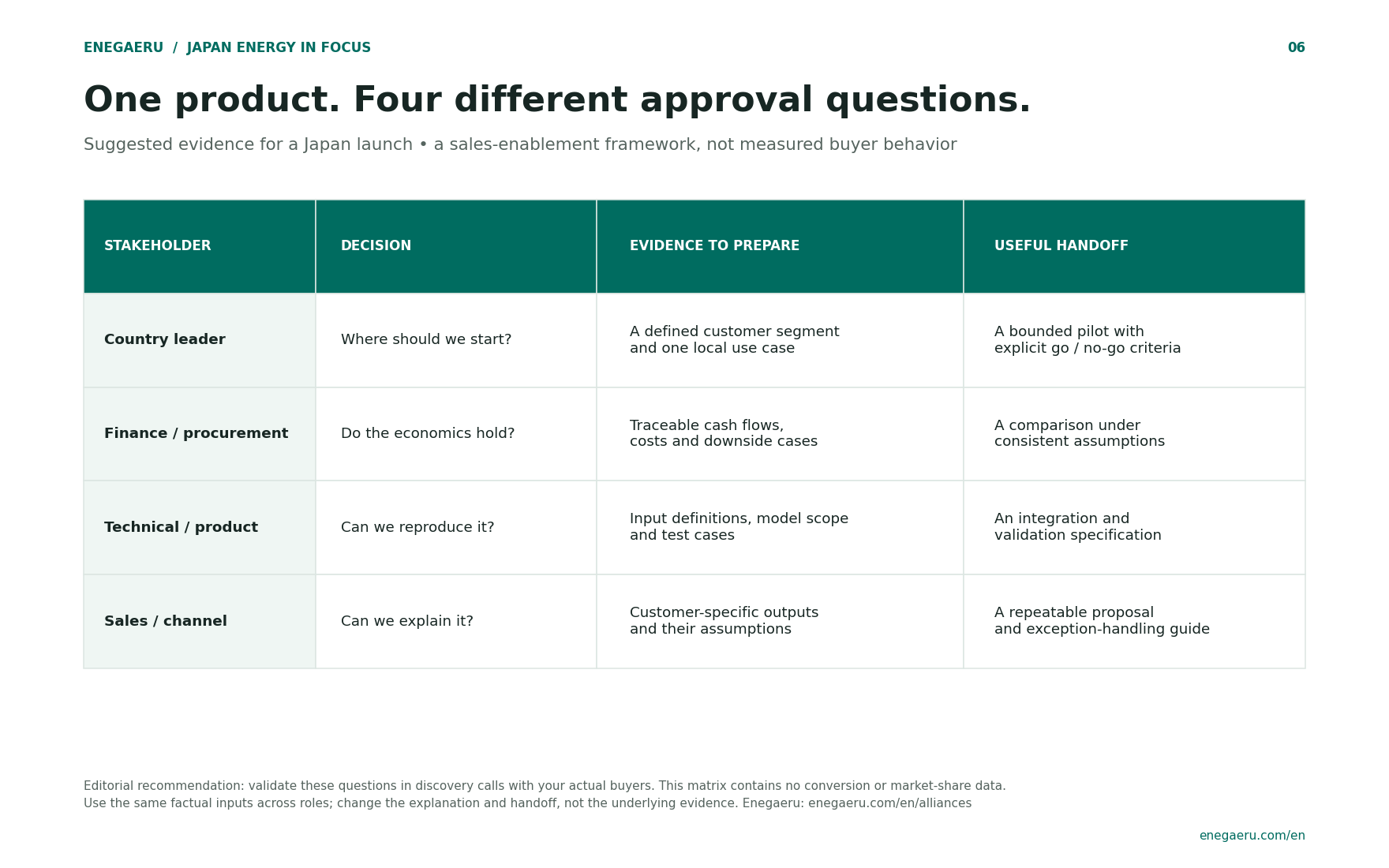
Read the diagram, assumptions and sources
- Country leader: Which segment and local use case should we start with? Prepare a bounded pilot and explicit go/no-go criteria.
- Finance and procurement: Do the economics hold? Prepare traceable cash flows, costs and downside cases under consistent assumptions.
- Technical and product: Can the result be reproduced? Prepare input definitions, model scope, test cases and an integration specification.
- Sales and channel: Can the result be explained to a customer? Prepare customer-specific outputs, assumptions and an exception-handling guide.
This is a suggested discovery and sales-enablement framework. It is not a survey of Japanese buying behavior and contains no measured conversion uplift. Validate it with the people involved in your actual target accounts.
Four evidence layers point to one planning problem—but not one market.
The sources differ in scale, maturity and purpose. Reading them together is useful because each exposes a different interface that an overseas entrant must resolve.
| Evidence | Confirmed facts | Decision for an entrant | Boundary |
|---|---|---|---|
| Planned AI infrastructure | JERA, Dell Technologies and RHAELM announced an MoU on 1 October 2026. The first planned application in Chiba is described as using up to 400 MW of power capacity, a behind-the-meter arrangement at an operating thermal power station and a target around 2028. | Can power, cooling, compute and connection responsibilities be designed as one repeatable delivery model? | This is a development plan, not an operating result. The announced energy basis includes gas-fired power; it is not evidence of renewable or zero-carbon operation. |
| Two workload-shifting implementation models | Separate consortium announcements on 7 and 8 October 2026 describe two projects that began in August and run through February 2027. The first spans academic and industry data centers and proposes common interfaces and governance. The second connects AI data centers in Yokohama and Kitakyushu, using generator forecasts and trading prices alongside power, compute, disaster and network information. | Which workloads may move, which operating data may be shared, and does an open multi-operator model or a two-region, generator-data-led pilot match the entrant’s role? | Both are time-limited demonstrations under the same ministry program, with one participant in common. They are counted as two distinct projects—not as the combined number of participating organizations—and neither is a commercial rollout or published operating result. |
| Hourly carbon-free matching pilot | NTT Anode Energy, JERA Cross and NTT DOCOMO announced a pilot beginning 1 October 2026 using multiple solar plants, one grid battery and several communications buildings in western Japan. The assessment uses operating data and an EnergyTag-aligned platform. | What time resolution, storage dispatch, shortfall treatment and cost trade-off are required for the intended carbon claim? | The release describes a simulation. It does not change supply contracts or transfer environmental value. |
| Government support call | Japan’s Ministry of the Environment opened the FY2026 second call on 17 September 2026 for a program intended to accelerate zero-emission and regionally compatible data centers. The stated application deadline is 16 October 2026 at noon JST. | Does the project design meet the detailed eligibility, local-coexistence and evidence requirements before the deadline? | A policy objective and open call do not guarantee entrant eligibility, selection, funding or project economics. The implementing body’s current guidance controls the application. |
Common change: power supply is being discussed alongside the operating facility, workload placement, the evidence layer or the local implementation framework—not as a bill to optimize after the technology is deployed. Important difference: the sources do not describe the same commercial model. One concerns large-scale AI infrastructure, two test different workload-orchestration boundaries, one is a carbon-free matching simulation and one is public support. Their costs and outcomes are not comparable.
This is an early signal, not proof that every Japanese data-center or energy customer is adopting the same architecture. Enegaeru is not presented as a participant in any cited project or public program.
Past comparison and background
The evidence is moving closer to operating constraints.
From project-by-project integration to a repeatable architecture
JERA’s release frames the existing problem as repeated integration of power, electrical systems, cooling and compute for each project. The proposed framework is intended to standardize that work. That is the issuer’s design objective; there is not yet an operating track record showing that it reduces lead time or cost.
From fixed-site capacity to orchestrated workload placement
The two workload-shifting projects add different operating models to the earlier site-led evidence. The twelve-organization project tests a broader multi-operator environment and proposes common interfaces and governance. The J-POWER-led project narrows the geography to Yokohama and Kitakyushu and adds generator-native forecasts and trading prices to the placement decision. For an overseas entrant, choosing the control boundary now matters alongside workload eligibility, latency and data-locality limits, interface definitions, decision rights and settlement logic.
Editorial interpretation: location-flexible compute could become a demand-side resource only where workloads are movable and the parties can share and act on the required data. Counterevidence and limits: two projects are stronger evidence of an emerging design problem than one project alone, but both sit under the same public program, share one participant and remain time-limited demonstrations. They do not yet establish delivered energy savings, service levels, customer willingness to pay, cybersecurity acceptance, a commercial contract or a market-wide interface standard.
Hourly evidence is becoming a separate procurement layer
Three independent cases now test different parts of the same question: whether renewable procurement can be evidenced at the time electricity is consumed, rather than only balanced over a longer reporting period. They do not establish a market-wide standard, but they make the decision more concrete for buyers, suppliers and data-platform providers.
| Case and stage | What it tests | Decision implication |
|---|---|---|
| J-POWER, Mizuho and Scalar Proof of concept completed; announced 17 April 2026 | Hourly matching across a customer load and multiple non-fossil sources, with traceability and data authenticity on a shared platform. | A supplier may need to assemble several resources and an auditable data chain. The announcement confirms technical feasibility in the test, not a live nationwide product or customer contract. |
| NTT Anode Energy, JERA Cross and NTT DOCOMO Simulation pilot from 1 October 2026 | Solar generation, one grid-scale battery and multiple buildings, including the relationship between the hourly carbon-free supply ratio and economic conditions. | Storage operation, charging provenance, meter boundaries and shortfall treatment can change both the carbon case and the cost case. The pilot does not change supply contracts or transfer environmental value. |
| UPDATER and Taiwan NPC MOU signed 1 September; announced 2 October 2026 | A cross-border collaboration combining procurement knowledge with electricity traceability technology for Japan, Taiwan and other Asian markets. | Hourly evidence may become part of regional offer design, but the MOU is an intention to collaborate. It does not demonstrate a commercial service, buyer adoption or reporting acceptance. |
Editorial interpretation: annual renewable volume and hourly evidence should be treated as different scopes of work. A Japan pilot should define the data interval, meter and grid boundary, generation location, environmental-attribute ownership, storage-charging treatment, shortfall rule and validation method before anyone prices or markets the carbon claim.
Counterevidence and limits: one case is a completed proof of concept, one is a simulation pilot and one is an MOU. None makes hourly matching mandatory across Japan, proves willingness to pay or settles how every reporting framework will treat the evidence. The pattern is therefore an early directional signal, not a forecast of broad adoption.
From a technical project to a local policy case
The Ministry of the Environment call adds a public-interest layer: renewable-energy use and coexistence with the region. An overseas team therefore needs to distinguish a technically workable design from an eligible, locally supportable application. The public press notice is not enough to determine eligibility; the latest detailed guidance and project-specific advice are still required.
Wider editorial interpretation: high and variable loads, constrained connection options, stronger interest in time-based carbon evidence and policy conditions can bring energy decisions forward in the launch sequence. Alternative explanation: the cited developments may remain exceptional large-company projects and time-limited pilots rather than become a broad purchasing pattern.
PPA is not one contract: choose the evidence boundary before the price.
Three independent company disclosures published from 29 September to 1 October 2026 show three different ways a corporate buyer can secure renewable energy or its environmental value in Japan. They are comparable as contract-design evidence, not as projects: the technologies, capacities, customers, delivery dates and stated emissions calculations differ.
| Structure and disclosed stage | Confirmed project facts | Boundary an entrant must design |
|---|---|---|
| On-site, self-consumption DNP Izumizaki Plant; announced 29 September 2026; generation planned for June 2027 | DNP disclosed 10,813 kW of solar panels on the factory site under an on-site PPA. It expects about 6,332 tonnes of annual GHG reduction. The estimate and schedule are not operating results. | Site control, construction and interconnection scope, asset ownership, meter position, operations, maintenance and the method used to reconcile actual generation with the customer load. |
| Off-site, physical retail supply Tohoku Hirose Electric; supply began 1 October 2026 | Tohoku Electric disclosed a 20-year supply from six off-site solar plants with 267.3 kW of combined rated output to the Miyako plant through the grid. The release estimates about 220 tonnes of annual CO2 reduction using a stated emissions factor. | Generator, retailer and network roles; physical delivery terms; shortfall and surplus treatment; balancing and delivery charges; and allocation of environmental attributes. |
| Virtual PPA for environmental value Three Toyota-affiliated companies; value supply began 1 October 2026 | Eurus Green Energy disclosed contracts supplying roughly 60 million kWh per year of non-FIT non-fossil certificates from a FIP-converted wind farm. The release describes environmental-value transactions, not physical delivery of that project’s electricity to the buyers. | Certificate allocation and retirement, financial or settlement terms, FIP and aggregator roles, electricity procurement outside the VPPA, and the claims the buyer intends to support. |
Editorial interpretation: the first design choice is the delivery and evidence boundary, not a headline PPA price. On-site procurement concentrates more execution at the customer site. Off-site physical supply adds retailer, network and balancing interfaces. A virtual PPA separates environmental value from the buyer’s physical electricity supply. These distinctions affect data, contracts, risk ownership and what can be claimed.
Decision for an overseas entrant: define the asset and meter boundary, who owns and operates the asset, whether electricity or only environmental value is delivered, who acts as retailer or aggregator, how shortfalls and certificates are handled, the commercial-operation date, and the assumptions behind any emissions estimate. A PPA label alone does not establish hourly matching, additionality, cost savings, resilience or reporting acceptance.
Counterevidence and limits: these are three company-selected cases, not a representative sample of Japan’s corporate procurement market. One project is planned while two had begun their disclosed supply on 1 October. The announcements do not provide comparable prices or realized performance, and they do not show that one structure is generally superior.
The value chain shifts from a product sale to an auditable operating case.
| Stage | Opportunity | New barrier or risk | Evidence to prepare |
|---|---|---|---|
| Siting and power | Co-design generation, connection, facility load and phased capacity instead of optimizing them separately. | A prominent behind-the-meter example may not be replicable at another site; grid, land, fuel and engineering conditions remain project-specific. | Capacity by phase, meter boundaries, connection dependencies, demand profile and responsible parties. |
| Tariff and procurement | Compare self-supply, retail supply, on-site or off-site PPA and storage on a common customer baseline. | An average electricity price can obscure contract capacity, time effects, adjustments, balancing and negotiated terms. | Applicable contract, billing rules, interval demand, procurement terms and dated price assumptions. |
| Optimization and carbon data | Use dispatch, forecasting and traceable data to quantify the cost of moving from annual to more granular matching. | Simulation results, certificates and physical supply answer different questions. Unsupported claims create commercial and reporting risk. | Time interval, generation source, battery provenance rules, shortfall treatment, environmental attributes and validation method. |
| Local delivery and policy | Localize the proposal, application evidence and stakeholder handoff for a defined region and use case. | Support programs are time-limited and conditional; regional coexistence cannot be reduced to a generic subsidy assumption. | Current eligibility guidance, permits and approvals, local responsibilities, operating plan and exit conditions. |
What this means for revenue design
A hardware margin, software fee, energy spread, PPA payment and consulting fee depend on different risk owners and evidence. Keep customer bill savings separate from market revenue, carbon claims and public support. A model that works only when all four are treated as guaranteed is not ready for a Japan pilot.
What an overseas entrant should decide now
- Which customer and meter boundary the first offer serves.
- Which party owns generation, storage, environmental attributes and dispatch decisions.
- Which claim is being sold: cost reduction, resilience, capacity, carbon evidence or a defined combination.
- Which local data and approvals are required before a commercial quote.
- Which downside case would stop the pilot or change the delivery model.
Five decisions to resolve before scaling.
1. Define the customer and the meter boundary.
Separate residential solar-plus-storage, commercial self-consumption, EV charging and grid-scale battery projects. They need different inputs and commercial tests. Specify which loads and assets sit behind the customer’s meter, what can export, who buys electricity and who owns the equipment. For a data center, also distinguish IT demand from total facility demand and define how demand changes as capacity comes online.
Useful first deliverable: a one-page diagram of the energy flows, contracts and parties responsible for each data input. Treat an assumed connection date as an open dependency until the responsible party confirms it.
2. Rebuild the bill using the applicable contract.
A single average electricity price can hide the value of shifting consumption. Ask for the supplier, service area, voltage class, contract capacity, tariff, adjustment provisions and billing period. TEPCO Energy Partner’s explanation for corporate customers describes monthly fuel-cost and market-price adjustments and notes revisions effective 1 April 2026. Its rules are evidence for those plans, not a universal formula for every Japanese supplier. See TEPCO’s explanation (Japanese) →
For a proposed service, compare your reconstructed baseline with an actual bill. Record which components are included, their applicable month and whether tax is included. Identify negotiated terms that must be entered separately from a standard tariff database.
3. Model energy when it is used.
Annual generation and annual consumption do not establish how much solar a customer can use on site. Align the demand and generation profiles at the time resolution required for the decision. For battery storage, state usable capacity, power limits, conversion losses, standby consumption, reserve settings and dispatch assumptions. For BEV/V2H, include vehicle availability, driving demand and charging or discharge limits.
Keep the value of customer bill savings separate from potential market revenues. Where a project relies on aggregation, grid services or merchant trading, obtain the applicable participation rules and a separately validated revenue model. A behind-the-meter simulation alone does not establish grid-scale BESS returns.
4. Compare the ownership and procurement choices.
Self-ownership, an on-site PPA, an off-site PPA and a lease change who pays, who owns the asset and which risks remain with the customer. Compare options on a consistent period and demand profile. Include the relevant installation, operation, replacement, financing, energy procurement and end-of-term assumptions.
For off-site procurement, define the treatment of shortfalls, surplus generation, balancing, delivery charges and environmental attributes under the proposed contract. Keep physical electricity supply, cost savings, continuity of supply and carbon-accounting claims as separate review items. Have the responsible specialists validate contract and reporting requirements.
Recent on-site, physical off-site and virtual PPA disclosures reinforce this separation. Start by deciding what crosses the commercial boundary—electricity at the customer site, electricity delivered through a retailer, or environmental value—then model the associated data and risk owners.
5. Maintain effective-dated local inputs.
A convincing pilot can become expensive to maintain if every proposal requires a new spreadsheet. Assign responsibility for tariff changes, subsidy eligibility, equipment specifications and policy updates. Define how a changed input reaches the application, who reviews it and how a previous proposal can be reconstructed.
Confirmed facts: four regional electricity retailers disclosed tariff revisions linked to network-charge changes, all effective 1 November 2026. The implementation boundaries were not uniform.
| Retailer disclosure | Announced | Disclosed scope | Operational implication |
|---|---|---|---|
| Hokkaido Electric | 25 September 2026 | Low-voltage and high-/extra-high-voltage customers | Voltage class belongs in the version key. |
| Chugoku Electric | 28 September 2026 | All contracted customers; some non-price supply conditions also revised | Do not treat a tariff update as unit-price replacement alone. |
| Okinawa Electric | 28 September 2026 | All supply contracts; billing periods crossing 31 October are prorated | Effective-date and proration logic must be reproducible. |
| Kansai Electric in the Tokyo area | 5 October 2026 | Specified low-voltage plans in the Tokyo service area | Retailer, service area and plan must be separate fields. |
Editorial analysis: a common effective date does not create a common calculation rule. A Japan-ready proposal workflow should identify the retailer, service area, voltage class, plan, tax treatment, effective period, proration rule, source, reviewer and version history. Otherwise the same customer profile can be evaluated against the wrong baseline, distorting the apparent value of a PPA, storage system or tariff-switching proposal.
Limit: these four disclosures show a cross-regional operational pattern, not the full retail market. They do not establish that every supplier or plan changes in the same way. Negotiated high-voltage contracts, market-linked components and customer-specific terms still require contract-level confirmation.
This is also a practical build-or-buy decision. Keep the user experience and product differentiation that matter to your business. Evaluate whether maintained Japanese data, calculation APIs or a managed simulation workflow can reduce the work your team must repeat. Enegaeru can be considered for tariff data and calculation support within its documented product scope; it does not replace contract review or guarantee that every negotiated term is covered.
Choose a pilot that tests your commercial assumption.
| Your business | Question to test | Evidence to prepare |
|---|---|---|
| Residential solar, batteries and all-electric homes | Which customer profiles justify the proposed equipment and tariff combination? | Consumption pattern, tariff, solar yield, usable storage, equipment losses, installation quote and applicable support. |
| Commercial and industrial energy solutions | How does the proposal change an actual site’s energy costs and cash flow? | Interval demand, roof/site conditions, operating calendar, export limits and a common cost baseline. |
| BEV, charging and V2H | Can the proposed vehicle and charging pattern deliver the intended customer benefit? | Mileage, availability, charging power, energy prices, equipment compatibility and battery reserve assumptions. |
| Retailers, PPA providers and energy software | Can the service quote consistently across the target sites and contracts? | Tariff rules, procurement structure, demand and generation profiles, exception handling and validation cases. |
A focused pilot your team can review.
- Select a representative case. Choose a real target customer profile and state why it represents the segment. Record anonymized or authorized data, its period and known gaps.
- Agree on the baseline. Reconcile demand and billing inputs before adding a solar, storage, charging or procurement option. Keep estimated values visibly distinct from measured data.
- Compare a small number of alternatives. Use the same accounting period and consistent treatment of tax, subsidies, replacements and financing. Include a downside case in which a critical assumption changes, such as lower self-consumption or higher installation cost.
- Review the result with the people who will use it. Ask the commercial team whether it supports a credible proposal, the technical team whether the constraints are respected and the finance team whether the cash flows are traceable.
- Define what makes the next case repeatable. Retain the input definitions, source dates, model settings, review notes and approved explanation. Decide which steps belong in software and which need expert handling.
A useful acceptance criterion is specific: another authorized team member can reproduce the comparison from the recorded inputs and explain why the alternatives differ. Set timing, accuracy tolerances and deliverables with your project team; this outline is not a promised delivery schedule.
Where Enegaeru can support your Japan launch.
Enegaeru is Kokusai Kogyo’s family of energy simulation services, APIs and supporting services. Start with the workflow you need to deliver, then confirm the suitable product and scope.
- Localize the calculation and data layer.Japanese electricity tariff and subsidy data and simulation APIs can support an application that needs Japan-specific inputs. Confirm coverage, update timing, permitted use and negotiated-tariff handling for your target segment.
- Validate customer economics before a wider rollout.Explore residential solar and storage, commercial and industrial simulation, EV/V2H and corporate PPA services. Capabilities differ by product.
- Use expert delivery where the inputs need work.BPO and simulation support can be scoped around data preparation, comparisons and outputs, with responsibilities and assumptions agreed before work begins.
- Keep policy interpretation distinct from live data.Energy Policy TRACKER provides a route to monthly Japanese energy-policy and council intelligence. Report language and optional support require confirmation; an English introduction does not guarantee English report delivery.
- Explore the wider implementation context.Kokusai Kogyo’s geospatial expertise can inform a discussion about location-dependent needs. Alliance and consulting discussions can establish which capabilities and relationships are relevant. Introductions, data rights and project participation are agreed case by case.
These services support defined analysis and implementation tasks. They do not replace grid-connection approval, detailed engineering, regulatory advice or project-specific financial due diligence.
Questions from international teams.
Can a tariff database replace every customer contract?
No. Confirm the plan and applicable date, then check for negotiated prices, bespoke adjustments and other contract-specific terms. Treat the database as an input source with defined coverage.
Does an electricity supply agreement establish a renewable-energy claim?
The supply agreement alone does not answer every environmental-attribute or reporting question. Review the generation, certificates, ownership and applicable reporting framework with the responsible specialists.
Should we build an integration before testing a customer case?
A scoped simulation or BPO exercise can help define data requirements and acceptance criteria first. An API integration becomes easier to specify once your team knows which decisions and outputs it must support.
Does this article describe an Enegaeru partnership with the organizations cited?
No. Their public announcements are evidence used for independent analysis. No project participation, partnership or endorsement is implied.
Conditional outlook: watch the evidence, not the announcement count.
Base hypothesis: Japan market-entry teams serving data-intensive facilities will increasingly need a joined-up power, economics and carbon-data case before moving from partnership discussion to repeatable sales.
Evidence that would strengthen the hypothesis
- The Chiba project or other independent projects publish binding milestones, operating designs and delivered performance rather than only planned capacity.
- The two workload-shifting projects publish comparable results for workload movement, renewable curtailment or power response, compute overhead, network performance, service levels and commercial settlement.
- Hourly-matching projects move from proofs of concept and simulations to live commercial contracts, with disclosed matching performance, price implications and environmental-attribute treatment.
- Buyers, auditors or reporting bodies accept defined interval, location and verification methods, including transparent treatment of battery charging and unmatched hours.
- Public-program selections and completed projects show that zero-emission and regional-coexistence requirements can be implemented across more than one exceptional site.
- Additional operators with different business models adopt comparable meter, storage and data architectures.
Evidence that would weaken it
- Behind-the-meter integrated projects remain rare and cannot be reproduced under ordinary site or connection conditions.
- Workload-shifting demonstrations cannot convert to commercial operation because latency, data-locality, interface, cybersecurity, governance or settlement constraints outweigh the power-system value.
- Hourly matching remains a voluntary experiment without buyer willingness to pay, a clear reporting use or independently accepted verification.
- Proofs of concept cannot convert to commercial offers because the cost premium, data burden or supply shortfalls outweigh buyer value.
- Public support is not renewed, eligibility proves too narrow or selected projects do not reach operation.
Also watch final changes to relevant carbon-accounting rules rather than treating proposals as settled requirements. Until these indicators are available, treat the trend as a planning hypothesis. Use it to design better pilots, not to forecast nationwide demand or guarantee a revenue model.
Sources, method and limits.
- JERA: MoU with Dell Technologies and RHAELM, published 1 October 2026. Source for the proposed framework, Chiba project, power capacity, behind-the-meter arrangement, energy basis and target timing.
- MESH-X, partner organizations and Tokyo Electric Power Company group: wide-area workload-shifting social demonstration (Japanese PDF), published 7 October 2026; demonstration stated as running from August 2026 through February 2027. Source for the consortium scope, orchestrator inputs, staged demonstrations and stated plans for common interfaces and governance. It is one consortium event, not twelve independent cases, and is not evidence of a commercial rollout or operating result.
- J-POWER, Cisco Systems, JR East, Hitachi and Bitmedia: workload-shifting demonstration between Yokohama and Kitakyushu AI data centers (Japanese), published 8 October 2026; work stated as running from August 2026 through 1 February 2027. Source for the two-region design, generator forecasts and trading-price inputs, network approach and evaluation of renewable-curtailment, electricity-cost and compute-overhead effects. This is a separate project under the same ministry program as the 7 October consortium disclosure, with MESH-X participating in both; it is not a commercial rollout or operating result.
- J-POWER: results of the 24/7 corporate PPA proof of concept with Mizuho and Scalar (Japanese), published 17 April 2026. Source for the completed test scope, multiple-resource hourly matching, traceability and stated next-stage development.
- NTT Anode Energy, JERA Cross and NTT DOCOMO: solar-plus-storage hourly-matching pilot, published 29 September 2026. Source for the pilot scope, earlier-pilot comparison, participant roles, EnergyTag-aligned platform and simulation boundary.
- UPDATER: MOU with Taiwan NPC on renewable procurement and traceability (Japanese), published 2 October 2026; MOU dated 1 September 2026. Source for the stated collaboration scope and hourly-matching direction; it is not evidence of a launched service or outcome.
- Ministry of the Environment: FY2026 second call for the data-center zero-emission and regional-coexistence acceleration program, published 17 September 2026. Source for the policy objective and call period; detailed eligibility is controlled by the implementing body’s current materials.
- DNP: on-site solar PPA at the Izumizaki Plant (Japanese), published 29 September 2026. Source for the planned 10,813 kW installation, June 2027 start, self-consumption structure and issuer-estimated GHG reduction; the estimate is not an operating result.
- Tohoku Electric: off-site corporate PPA for Tohoku Hirose Electric (Japanese), published and started 1 October 2026. Source for the six plants, 267.3 kW combined rated output, 20-year retail supply and stated emissions-factor basis.
- Eurus Energy: virtual PPAs using a FIP-converted wind farm (Japanese), published and environmental-value supply started 1 October 2026. Source for the non-FIT non-fossil certificate volume, project boundary and stated customer scope; it is not physical delivery from the project to the buyers.
- Hokkaido Electric: tariff revision accompanying network-charge changes (Japanese), published 25 September 2026 and effective 1 November 2026. Source for the disclosed low-voltage and high-/extra-high-voltage scope.
- Chugoku Electric: electricity menu revision reflecting network-charge changes (Japanese), published 28 September 2026 and effective 1 November 2026. Source for the all-customer scope and revision of some non-price supply conditions.
- Okinawa Electric: electricity-rate revision following network-charge changes (Japanese), published 28 September 2026 and effective 1 November 2026. Source for the all-contract scope and proration across the effective date.
- Kansai Electric: low-voltage menu revisions in the Tokyo area (Japanese PDF), published 5 October 2026 and effective 1 November 2026. Source for the service-area and specified-plan boundary; it is not evidence about data-center high-voltage contracts.
- TEPCO Energy Partner: fuel-cost and market-price adjustments (Japanese). Example of supplier-specific calculation rules and effective-date changes; not a universal formula.
- Enegaeru electricity tariff and subsidy API and commercial simulation API (Japanese). Product information; the linked English service pages explain available discussion routes.
Method: the core report compares a planned developer/supplier collaboration, two distinct workload-shifting projects under the same government program, a buyer-supplier pilot and a government call. The two workload projects are counted by project, not by participating organization, and one participant overlaps. For the hourly-evidence layer, we separately compared three independent cases at different maturity stages: a completed proof of concept, a simulation pilot and an MOU. For the contract-boundary layer, we compared three different corporate procurement cases—on-site physical supply, off-site physical retail supply and a virtual environmental-value agreement—without treating repeat coverage of the same case as another source. For the tariff-maintenance layer, we compared four regional-retailer disclosures with the same effective date but different voltage, plan, contract and proration boundaries. None of these groups is a market sample, and the sources do not prove causation or broad adoption.
Published 4 October 2026; sources rechecked and workload-orchestration analysis updated 11 October 2026. By Enegaeru, Kokusai Kogyo Co., Ltd. Confirmed facts are attributed above; value-chain implications, recommendations and the conditional outlook are editorial analysis. Project plans, application terms, tariffs, accounting rules and product scope may change. Confirm them for the date, site and contract under review.
Bring one Japan use case to the conversation.
Tell us your product, target customer, expected launch stage and the decision you need to make. If available, bring a sample tariff, demand profile and equipment specification. We can discuss a suitable starting scope for SaaS, APIs, BPO or a joint development project.